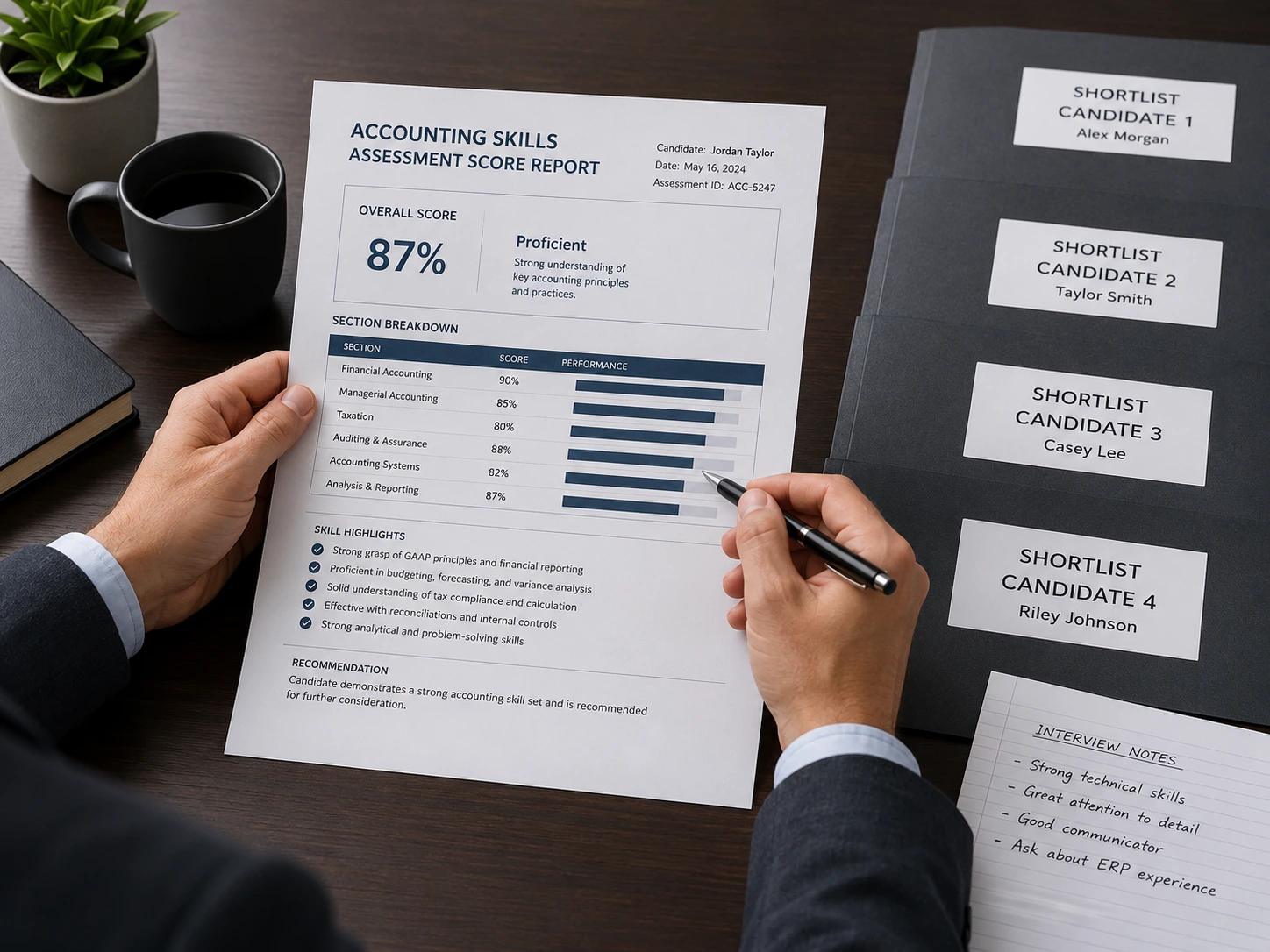
Pre-employment accounting tests are fast, inexpensive, and feel objective. That makes them useful. It also makes them easy to misuse.
A test that confirms a candidate can post journal entries does not confirm they can own a close cycle. Understanding the difference matters more than understanding the test itself.
What Accounting Skills Tests Actually Measure
Well-designed accounting assessments cover genuine technical ground. The strongest ones evaluate GAAP application in real scenarios, Excel and ERP proficiency (formulas, pivot tables, reconciliations), financial statement interpretation, bookkeeping accuracy across payables and receivables, and data entry precision under time pressure.
According to SHRM’s 2025 Talent Trends research, 73% of employers have now adopted skills-based hiring, up from 56% in 2022. In accounting specifically, this shift reflects the reality that a resume listing GAAP experience and a candidate who can apply it under pressure are two different things. Tests help bridge that gap.
What They Don’t Catch
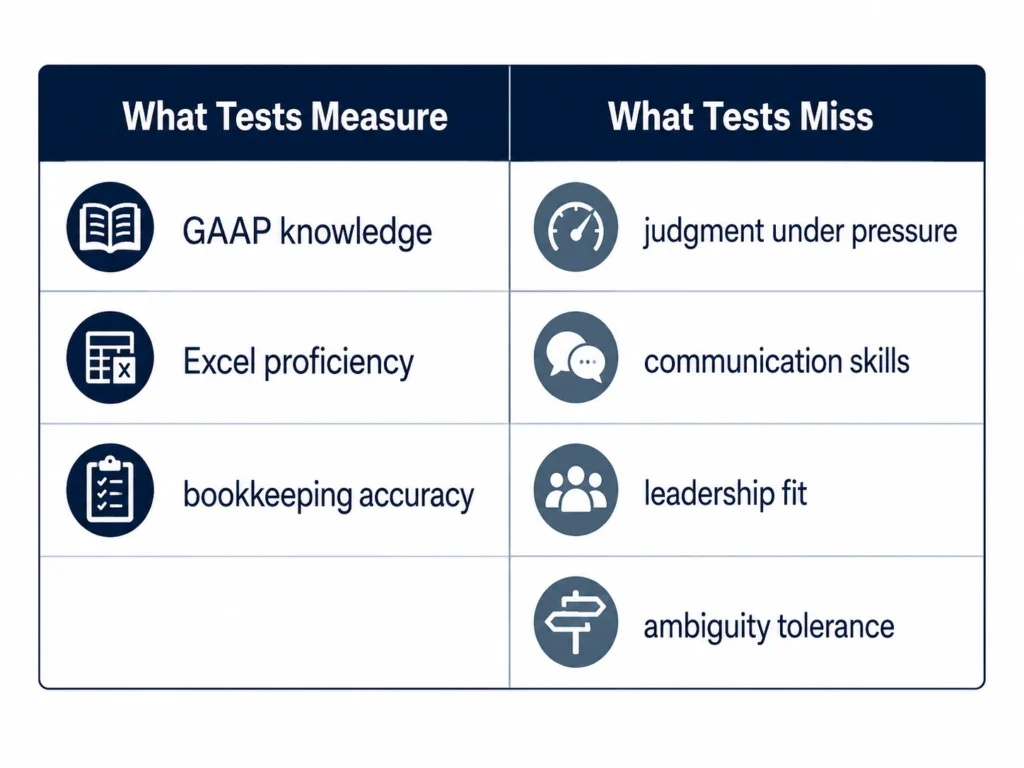
The limitation of accounting skills tests is not what they measure. It is what they cannot.
Tests do not measure how a candidate handles ambiguity. A line item that doesn’t reconcile, a controller who gives unclear direction, a system that’s down at month-end: these are the conditions where finance professionals earn their pay. No multiple-choice question simulates that.
They also do not measure communication. A senior accountant who builds clean reconciliations but cannot explain a variance to a non-finance VP is a limited hire. Tests miss this entirely.
They do not scale to seniority either. According to Gartner’s 2025 HR research on talent assessment, more than half of employers say determining whether candidates have both technical and soft skills is their hardest hiring challenge. One instrument rarely solves both problems. At the senior level, it rarely solves either.
When to Use Them and When Not To
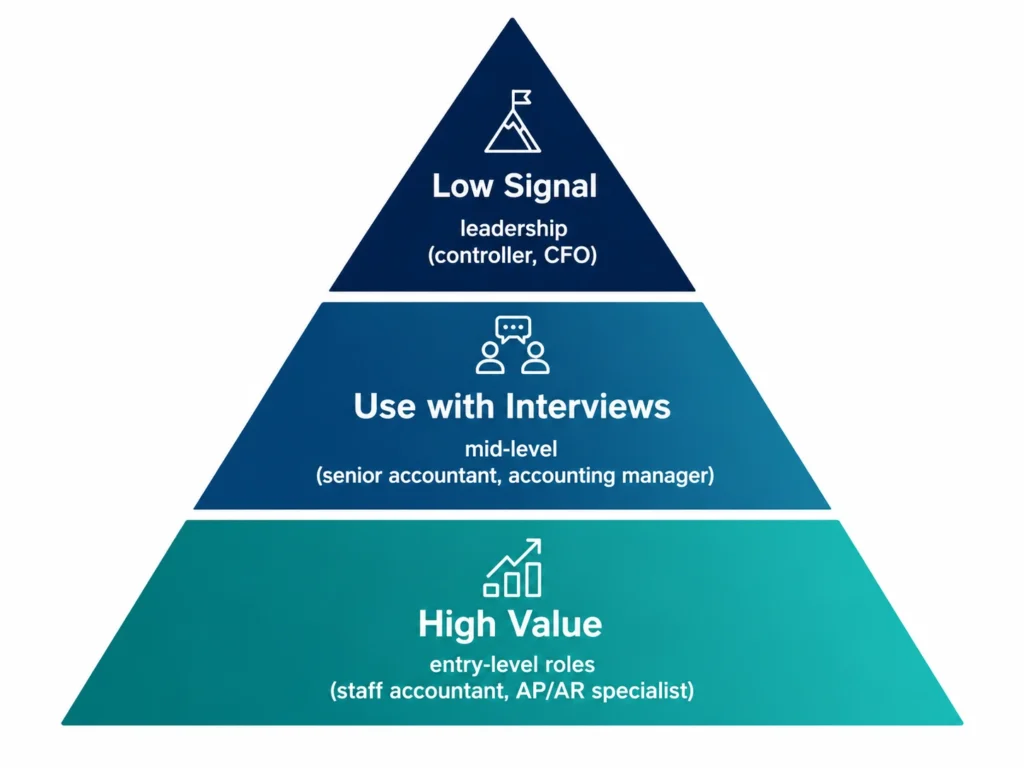
Tests add genuine value at the entry and mid-level of the accounting function, particularly for high-volume screening.
- For staff accountants, accounts payable and receivable specialists, and bookkeepers, a technical screen early in the funnel eliminates candidates who cannot do the core work before a hiring manager invests interview time. That is a legitimate return.
- For senior accountants and accounting managers, a test should supplement structured interviews, not replace them. Pair the technical screen with behavioral questions that probe judgment and communication directly.
- For controllers, CFOs, or any role where leadership is the primary requirement, skills tests are largely beside the point. The signal you need comes from how the candidate thinks and leads, not whether they can define accrual accounting.
How to Use Them Correctly
Use tests to narrow the field. Not to pick the winner.
- Pair them with work samples where possible. A short, role-specific reconciliation exercise reveals more than 40 multiple-choice questions. The exercise tests applied judgment, not memorized definitions.
- Validate the test against the actual role. An accounts payable test for an FP&A position wastes everyone’s time and tells you nothing relevant.
A 2025 Wall Street Journal report on AI and hiring notes that 65% of employers say AI-generated applications are complicating their ability to verify real skills. Skills tests are a reasonable partial solution to that problem. They are not a complete one.
The Takeaway
Tests narrow the field. They do not pick the winner.
Used at the right stage, for the right role, alongside structured interviews and practical work samples, they make screening faster and reduce reliance on gut instinct. Used as a single filter applied uniformly across all levels, they eliminate good candidates and provide false confidence about bad ones.
The tool is sound. The judgment about where to apply it is yours.