

Not every finance gap needs a permanent hire.
Some of the most costly mistakes in finance staffing come from treating every open role as a permanent position by default. The market does not reward that rigidity right now. Qualified finance professionals are scarce, permanent searches take weeks, and some of the work to be done is temporary.
Contract finance staffing is not a workaround. In a tight talent market, it is often the most rational decision available.
When Contract Is the Right Call
There are predictable situations where contract finance talent outperforms a permanent hire on speed, fit, and cost.
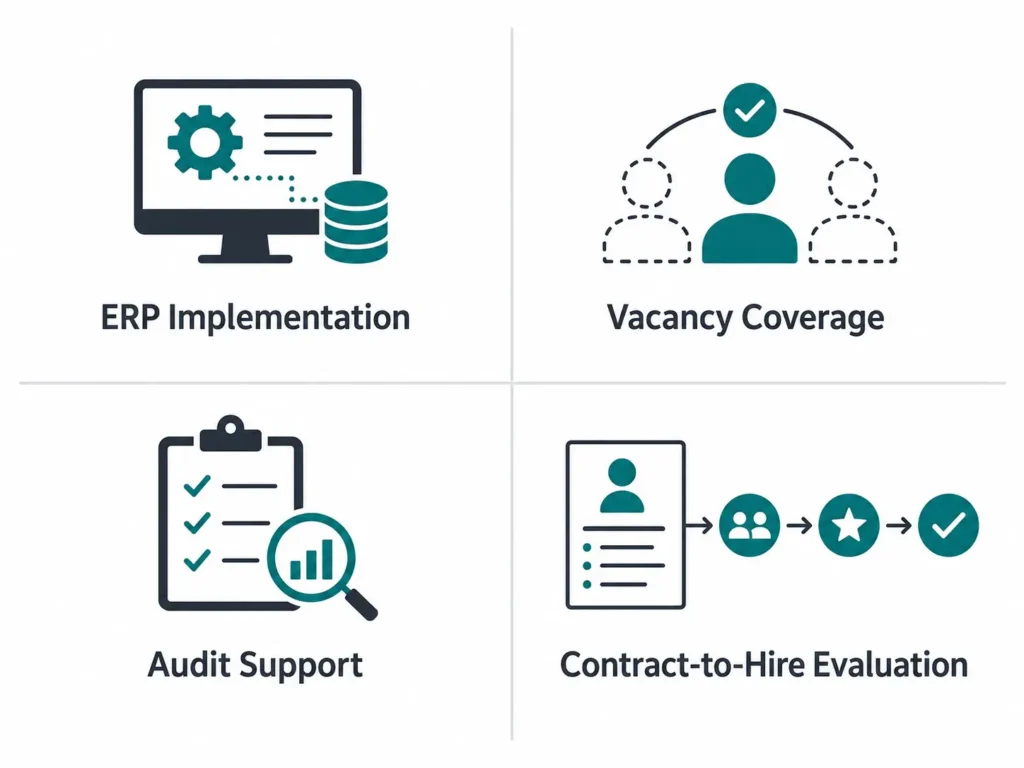
- System implementations. ERP transitions, software migrations, and finance technology upgrades require specific expertise for a defined window. A permanent hire brought in for a project either stays in a role that loses its original scope or leaves when the work is done. Neither outcome is clean.
- Coverage during a vacancy. When a controller, FP&A manager, or senior accountant departs, the work does not stop. Contract professionals maintain close execution and reporting accuracy while a permanent search runs in parallel. According to Century Group’s Q2 2026 employment report, month-end close slips three to seven days in lean teams, and audit cycles extend two to six weeks, generating incremental audit fees that can reach $100,000 to $500,000 for mid-sized filers.
- Audit and year-end support. Tax season and year-end close create predictable demand spikes. Contract accounting professionals handle those peaks without adding permanent headcount.
- Testing before committing. Contract-to-hire gives both sides a working evaluation measured in months, not interview hours. For mid-level roles where the right profile is uncertain, it meaningfully reduces the cost of a mis-hire.
Why 70% of Finance Leaders Are Already Doing This
According to Robert Half’s 2026 finance and accounting hiring research, approximately 70% of finance leaders now plan to increase their use of contract or temporary talent. The shift reflects both a structural talent shortage and a more disciplined approach to workforce planning.
The calculus is simple: When a permanent search for a senior accountant or controller takes an average of 73 days and the team is already short-staffed, the cost of waiting is measurable. Contract professionals bridge that gap without locking a budget into a permanent seat.
What “Good” Looks Like in a Contract Finance Hire

Not all contract finance professionals are interchangeable. The right one understands the specific systems, standards, and pace of the environment from day one.
Look for demonstrated experience with the relevant ERP (SAP, Oracle, NetSuite, Workday), direct familiarity with your industry’s compliance framework, and a record of delivering within defined timelines. References from prior contract engagements are a sharper signal than those from permanent roles, as they reveal how the person performs without the long runway of permanent employment.
How to Find One That Actually Fits
The most effective route is through a specialized finance staffing firm with an active network of vetted contract professionals, not a general-purpose staffing platform.
SHRM’s 2025 recruiting benchmarking data shows that organizations using specialized staffing partners fill roles faster and report a higher quality of hire. For a contract engagement that may need to start within days, that pre-built network is the entire advantage.
For senior contract roles, controller, interim CFO, and technical accounting lead, precision matters. A generalist firm with broad coverage and thin finance depth will deliver candidates who tick credential boxes but have never operated in a comparable environment.
The best contract hire is not the fastest available. It is the most precisely matched one. And finding that person requires a firm that has already built those relationships.